
How much a house actually earns on Airbnb is the question most owners ask themselves before deciding whether to convert their property to short-term letting. There isn’t a single answer: it depends on location, size, seasonality and management quality, but there are concrete parameters to estimate the return realistically.
The occupancy rate
The first element to consider is the occupancy rate, i.e. the percentage of booked nights out of the total available. In Italian tourist cities, a well-managed property reaches occupancy rates between 60% and 80% during peak season, with a natural drop in the weaker months. It’s the combination of occupancy and average nightly rate that determines the annual gross revenue.
A practical calculation example
To give a practical example: a two-room apartment in Florence with an average rate of 90 euros a night and an annual occupancy of 65% generates a gross revenue of about 21,000 euros a year. The same property let under a traditional lease would earn on average 9,000-10,000 euros a year, so the earning potential of short-term rentals can be more than double, though at the cost of higher management expenses.
A second example: a rate of 250 euros a night
Applying the same parameters as the previous example (65% annual occupancy) to a property with a higher average rate, say 250 euros a night, the annual gross revenue rises to about 59,300 euros (€250 x 365 nights x 65%). The same property let under a traditional lease would earn roughly less than half, confirming the greater earning potential of short-term rentals already seen in the case of the 90-euro apartment. Applying a management fee of 15-25% of turnover, the owner would be left with roughly 44,500-50,400 euros, and once all expenses are factored in (cleaning, linen, utilities, maintenance, platforms), the realistic net return falls in the 40-60% range of gross revenue, or roughly between 23,700 and 35,600 euros a year.
Expenses to deduct from gross revenue
From gross revenue you need to subtract the expenses specific to short-term rentals: platform commissions (roughly 10-15%), cleaning between stays, linen, utilities, more frequent maintenance and, if you rely on a property manager, the management fee, which in Italy typically ranges between 15% and 25% of turnover. The realistic net return, after all expenses, generally falls between 40% and 60% of gross revenue.
The importance of location
Location remains the most decisive variable: a property near tourist attractions, stations or central areas commands higher rates and more stable occupancy throughout the year. Conversely, peripheral properties or those in strongly seasonal destinations (sea, mountains) earn a lot during peak months but risk long vacancy periods during the rest of the year.
Property features
The property’s features also affect its earning potential: tasteful furnishings, professional photography, extra amenities (air conditioning, washing machine, parking, fast wifi) and an effective listing description all increase both the request-to-booking conversion rate and the average applicable rate.
Dynamic pricing
Dynamic pricing management, which adjusts rates based on demand, local events and seasonality, is one of the most effective tools for maximizing returns: it allows you to raise prices during periods of high demand and stay competitive during low-demand periods, avoiding empty nights.
Tax aspects
Before making estimates, it’s also important to remember the tax aspects: income from short-term rentals is declared either under the 21% flat-rate tax (“cedolare secca”, for the first property) or under ordinary taxation, and this needs to be factored into the final net return calculation, along with any CIN, insurance and regulatory compliance costs.
Withholding-agent manager or invoicing manager?
An aspect that directly affects the net return received by the owner, and which is often underestimated when choosing a manager, is the model with which the property manager applies its own fee. There are in fact two very different operating models. The first is the manager acting as a withholding tax agent (“sostituto d’imposta”): it collects guest payments, directly applies the 21% withholding required by the flat-rate tax, and pays the owner the amount already net of tax and commission, independently handling all reporting obligations to the tax authorities. The second model is the manager who does not apply the withholding, but issues a regular invoice to the owner for its commission: in this case it is the owner who must subsequently declare the entire gross income and pay the flat-rate tax (or apply ordinary taxation) when filing their tax return, while deducting the manager’s invoice as a cost.
From the point of view of actual net return, the two models can produce very different results depending on the owner’s tax situation: the withholding-agent model simplifies management and guarantees certainty about the net amount received month by month, while the invoicing model can be more advantageous for those with a specific tax regime (for example VAT-registered owners) or who want to manage cost allocation independently. It’s therefore essential, before entrusting a property to a manager, to understand which of the two models applies and to assess its actual impact on net return, beyond the commission percentage alone.
Where the owner’s real gain lies
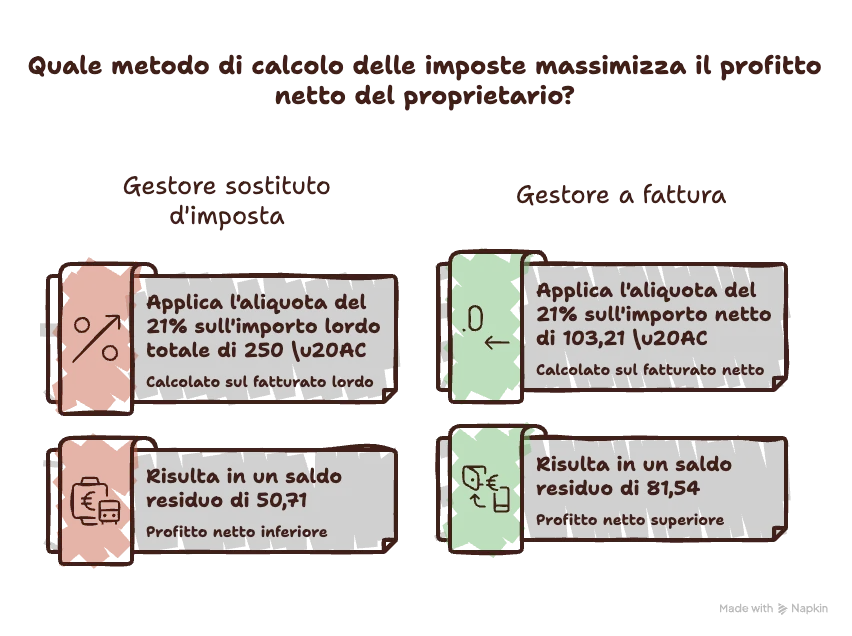
The difference between the two models lies not so much in the commission percentage applied by the manager, but in the taxable base used to calculate the 21% flat-rate tax: under the withholding-agent model the tax is calculated on the gross booking amount, while under the invoicing model it’s calculated on the net booking amount, i.e. after deducting all expenses incurred. Let’s look at the impact with a numerical example on a single 250-euro booking (the same rate used in the previous example), before scaling it up to an annual basis.
Expenses to deduct on the 250 € booking:
- OTA (18% + 22% VAT): €250 x 18% = €45.00 + VAT = €54.90
- Net after OTA: €250 - €54.90 = €195.10
- Cleaning (estimated flat cost): €40.00
- Net after OTA and cleaning: €195.10 - €40.00 = €155.10
- PM management fee (25% + 22% VAT, calculated on the net amount after OTA and cleaning): €155.10 x 25% = €38.78 + VAT = €47.31
- Payment processing costs (1.5% + 22% VAT, on the gross booking amount): €250 x 1.5% = €3.75 + VAT = €4.58
- Total expenses: €54.90 + €40.00 + €47.31 + €4.58 = €146.79
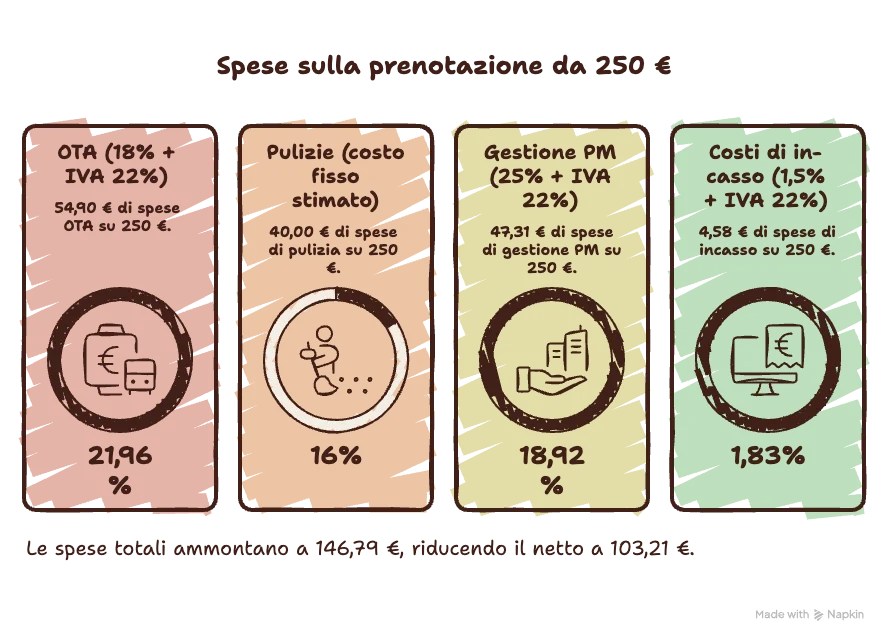
Net booking amount (€250 - €146.79) = €103.21
Case 1 - Withholding-agent manager (flat-rate tax on the gross amount):
- 21% flat-rate tax on €250 = €52.50
- The owner is left with: €103.21 - €52.50 = €50.71
Case 2 - Invoicing manager (flat-rate tax on the net amount):
- 21% flat-rate tax on €103.21 = €21.67
- The owner is left with: €103.21 - €21.67 = €81.54
On this single booking, the invoicing model generates €30.83 more for the owner than the withholding-agent model, purely as a result of the different taxable base.
Annual projection, keeping the 65% occupancy rate (365 nights x 65% = 237 equivalent nights a year):
- Case 1 (withholding agent): €50.71 x 237 ≈ €12,020 net a year
- Case 2 (invoicing): €81.54 x 237 ≈ €19,325 net a year
- Difference in favor of the invoicing model: roughly €7,305 a year

The gap, seemingly modest on a single night, becomes very significant on an annual basis: for the same rate, occupancy and management fee, the model with which the PM applies its commission can be worth thousands of euros of difference in the owner’s net return.
In summary
A house on Airbnb, when managed professionally, can earn significantly more than a traditional rental, but the actual return must always be calculated net of commissions, management costs and taxes. Relying on an experienced property manager who optimizes pricing, occupancy and service quality is often what makes the difference between a property that performs well and one that reaches its full earning potential.